


Creating a "progressive" London in ‘Virginia Woolf's Night And Day'
Production designer David Hindle speaks to Screen about turning Newcastle and Cologne into Edwardian London and Cambridge.
By Sandra Ubege 15 Jun 2026
When production designer David Hindle was approached to work on Virginia Woolf’s Night And Day, based on Virginia Woolf’s 1919 novel, he winced at the thought of doing a film from the Edwardian period, until director Tina Gharavi won him over.
“It’s not my favourite,” he says. “I think it can get quite fussy. In my first meeting with Tina, she had a spark about her. She said we're not making a period movie, what we're doing is relevant… It's not going to be bonnets and carriages, it needs to feel progressive.”
Although set mostly in 1910 London, with some scenes in Cambridge, the film shot on location towards the end of 2024 in Newcastle and the northeast of England, and Cologne, Germany. The period film world premiered this year as the opening film of SXSW London with Vue Lumiere releasing in the UK-Ireland on June 19.
Haley Bennett plays a passionate astronomer whose ambitions are thwarted by the patriarchal expectations of the society that surrounds her. Further cast includes Jack Whitehall, Jennifer Saunders, Sally Phillips and Lily Allen. Producers are the UK’s Asterisk Films and Piccadilly Pictures and Germany’s GLISK, with WestEnd Films repping sales.
Hindle, whose credits also include The King’s Speech, Bohemian Rhapsody and Matilda: The Musical, speaks to Screen about transforming Newcastle and Cologne into London and finding “stinky, in a good way” locations.
Why were Newcastle and Cologne chosen as the places to transform into Edwardian London?
There was an incentive to go and make [Virginia’s Woolf Night And Day] in Newcastle as the locations are a lot cheaper, and apart from a few key crew, me included, we would recruit locally. Cologne was the same. It’s in the North Rhine Westphalia region and that has 30% kickbacks on expenditure. A lot of films now keep swimming out to Europe, especially Germany. The government just increased the budget for its film production incentive scheme to €250m, which is incredible.
What were your favourite places/sets to shoot?
Eglingham Hall [in Northumberland] was fabulous. It was stinky, in a good way. It smelt of dogs, its owner was a heavy smoker, the curtains were a bit ragged. Everything there was just perfect. Walking through the door, I just had such a smile on my face. This is this is the world I wanted to create, and it's right here, better than you could ever make it.
What are the benefits of not shooting in London?
If you're shooting somewhere that's fairly new to filming, you will find interesting, exciting locations that you haven't been to before, and that's always a joy. I love working in London. I can work from home... London has the most extraordinary interiors of any city. But I think that filmmakers should be a bit more intrepid and explore Newcastle and Northumberland.
Were there any locations you found that surprised you?
Cologne, as charming and brilliant city as it is, didn’t offer any strong exteriors. It was levelled to the ground during the war, so there are very few period buildings left. We did find just outside Cologne Schloss Drachenberg, which are these sort of classic crazy Gothic German castles on a hillside, and within that building there was this wonderful gallery, which we used as Cambridge University.
How historically accurate were you in bringing buses and early cars to life?
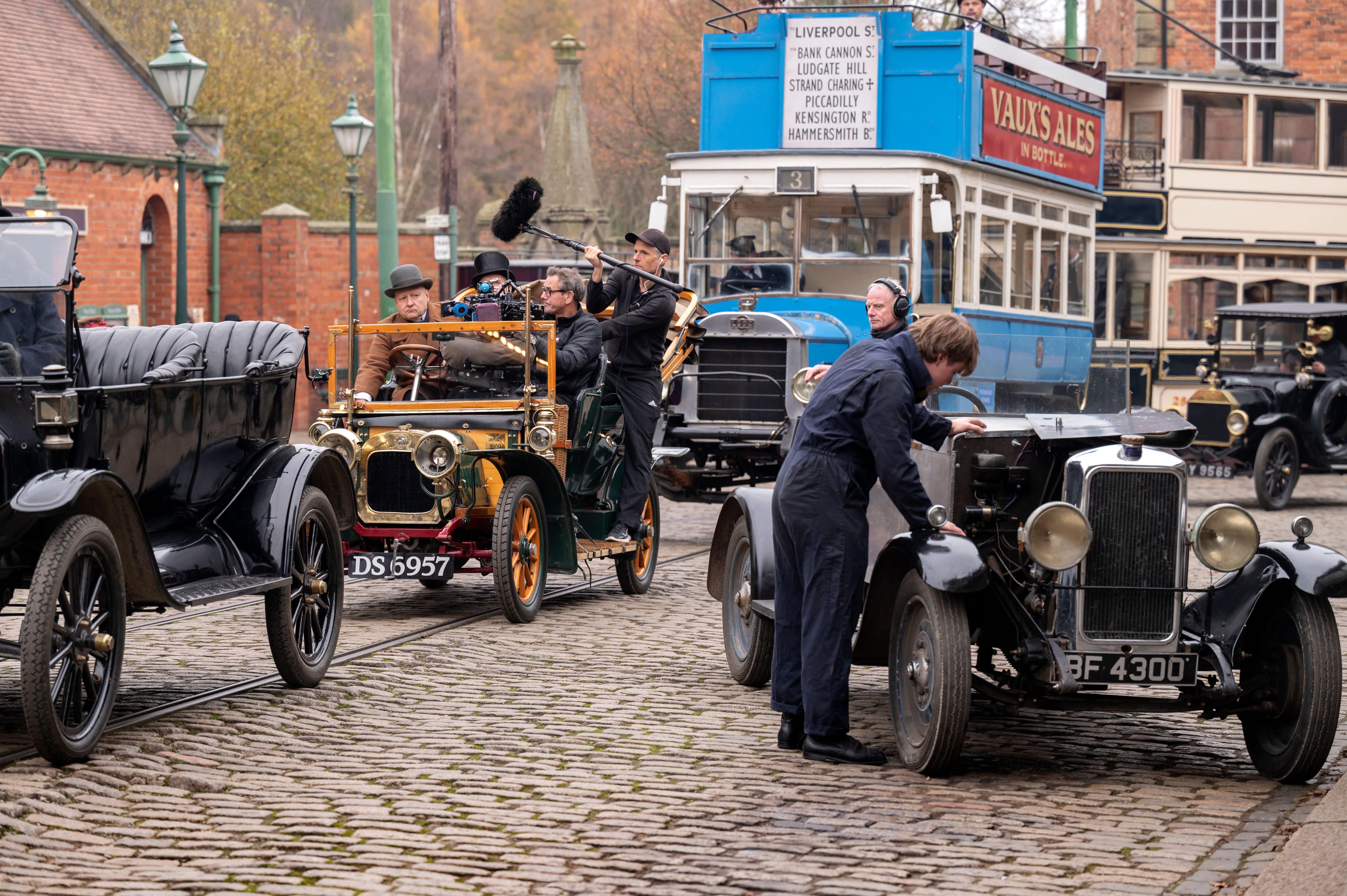
The vehicles are unbelievable. We owe a great debt of thanks to Beamish Museum. It’s an open-air museum and they knew everybody in the region who had cars that were pre-First World War. I remember the first day when they were driving up and down the street, it was so exciting.
How much was on location, and how much was studio space?
It's all location, bar a few minor builds. Newcastle was our key location. We had a couple of really good interior locations in Cologne but we also decided that it was the best place to do any small builds that we might need. We built a section of window for the scene where Haley has to climb out the window to grab her telescope as it’s not safe to do so on location.
What was the most challenging set to create and why?
A lot of decisions were made because our resources were stretched. Ryhope Pumping Station [in Sunderland] was the trickiest, because we built in a lot there to make Katherine’s [Haley Bennett’s character’s] office. There were cranks and beams whirring around us, it was like working inside a clock… it was absolutely stunning.
Where did you look for inspiration?
I would read a lot about Virginia Woolf and read around the period. I think the more you know about the period you're working in, the more you can subvert it a little.
Latest news & features
Featured profiles
Promote your services with Screen Global Production
Choose from three profile types - Basic, Silver and Gold
Create ProfileWe offer a range of display advertising opportunities.
Learn More