


Creating the unique visuals in 'Teenage Sex And Death At Camp Miasma'
Production designers Brandon Tonner-Connolly and Matt Hyland discuss matte glass paintings and fake snow.
By Cecilia Neri 10 Aug 2026
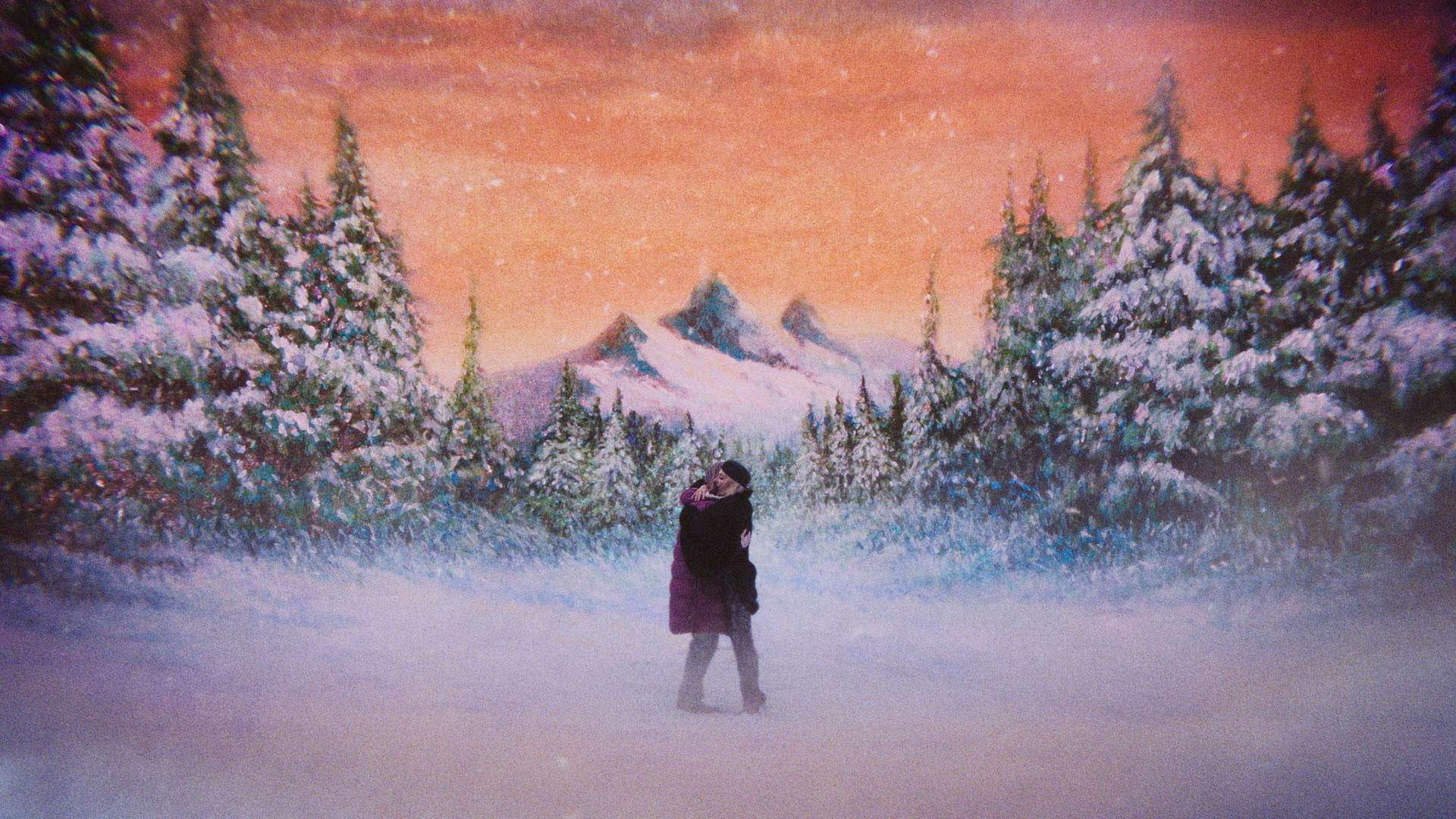
Before filming on Jane Schoenbrun’s Teenage Sex and Death At Camp Miasma began, production designers Brandon Tonner-Connolly and Matt Hyland knew that hand-painted backgrounds would be central to the visual language.
“We just couldn’t find anybody who had done this before”, says Tonner-Connolly. “It's true of our and Jane’s work that making it by hand is very key if you want the results to be something special.”
The horror film, which premiered at Cannes Film Festival in Un Certain Regard, follows a young director (Hannah Einbinder) attempting to revive a once-popular horror franchise with the star of the original film (Gillian Anderson). Mubi releases the title on August 7 in the US and August 21 in the UK.
Tonner-Connolly and Hyland speak to Screen about matte glass paintings, shooting in Vancouver and creating merchandise for a fake horror franchise.
What led you to pursue in-camera glass matte shots rather than relying on traditional VFX or CGI?
Tonner-Connolly: We were talking about these older pre-CGI effects and techniques, not just for making these beautiful landscapes, but mostly to bring the audience into the emotional landscape of the characters, and that's something that Jane had in mind. The landscapes are supposed to be these intentionally dreamlike visuals that act as portals to this fantasy world constructed by Billy; it's almost like Kris is stepping into her artwork when she gets closer to this world. We discussed the progression of it too, how it starts with this distant cityscape outside of Kris's hotel room. Then, Kris gets progressively closer and closer to them until she's finally absorbed into, and fully a part of the landscape with Billy.
Did you use classic films like Metropolis as a reference?
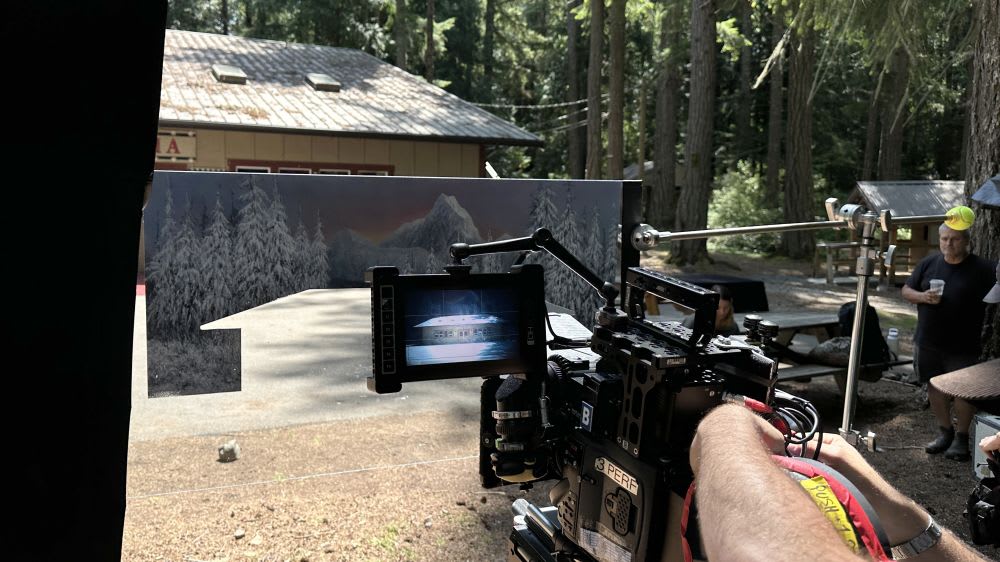
Hyland: Absolutely, back then thery were a lot more playful with how you layered or composed two-dimensional images as it was still the infancy in a lot of this technology. Because this is an indie film, we had to do all this prep while we were shooting everything else in the movie. This technique takes a lot of pre-setting. On this occasion, the decisions had to be made in advance; we were on location with Jane and Eric Yue the cinematographer, and then we lined up a shot. There really was no dress rehearsal, we just had to make this work and hope that it worked. If you plan your shot really well, what you paint on that glass to replace the background leaves behind half the scenery. It creates the illusion that it's all one image, that it's moving and dynamic, not just an inert background replacement.
What were the biggest challenges in adapting this technique for a modern production?
Tonner-Connolly: We couldn't actually find anybody who had done this before. I think there was one person in Vancouver who had used the technique for a Disney movie years ago, and they had recently passed away before we got there. It led to us doing a lot of research. There was a book called The Invisible Art, and another blog that we ended up looking toward, and these resources helped inform the process. We also collaborated with the scenic artist, a fine art painter, who had never done this sort of thing before. Not having anybody affiliated with the technique meant that we were thinking "okay, we've checked all the boxes that we possibly can, and we've done everything to ensure the success of this, but nobody can actually say this is going to succeed until the very moment that we're there doing."
What was the process of creating the paintings that Billy (Gillian Anderson) makes?
Tonner-Connolly: For the paintings, it started with conceiving of them with Jane; the general shapes, tones, and values. We started with the idea that the artwork is a way for Billy to process the trauma of her experience on the first Miasma movie. The repeating concentric square shape, the Little Death mask, and the different forms are a way of unravelling this knot she’s had from the first film. Then we started with the research, finding other artists that we felt could be right for this character. We looked at different artists, such as Josef Albers, and actually, the work of one of Jane’s friends.
The film required winter scenes to be shot during summer. What obstacles did that present?
Hyland: Vancouver is a very busy town, there are lots of experienced folks, and this guy, Kyle Moore [special effects coordinator] came in, and he was just so passionate about snow. He had been doing this for a long time; it was almost like he rolled in with a suitcase full of samples. I think as soon as we found him, some of the anxiety around snow was able to dial down quite a bit, and our excitement about it dialled up. We were not going to choose what was cheapest or the most efficient, we knew we were going to choose what looked right, and that meant practical snow, as much of it and as often of it as we possibly could. We could not physically reach some parts of the set, like on top of the roof, and we didn't have the equipment, so Niche, the VFX house, helped add a little bit of snow on the roof, and basically make the weather, light, and other kinds of four-dimensional factors sync on the same day
You also created an entire fictional horror franchise around Camp Miasma. What references helped make the merchandise feel authentic?
Tonner-Connolly: It was so much fun to invent 45 years of history of a of a film franchise that doesn't exist. We got into fan convention events and started to ask what the fans of Nightmare on Elm Street, Friday the 13th, Halloween, and sleepaway camp did in terms of merchandise over the course of their life. A week before production, we locked ourselves in a room, 12 angry men style, no cell phones, no distractions, we were not coming out of the room until we had planned out the opening credit sequence beat by beat by beat, and each beat was an object that we had to fabricate in one way or another.
Latest news & features
Promote your services with Screen Global Production
Choose from three profile types - Basic, Silver and Gold
Create ProfileWe offer a range of display advertising opportunities.
Learn More